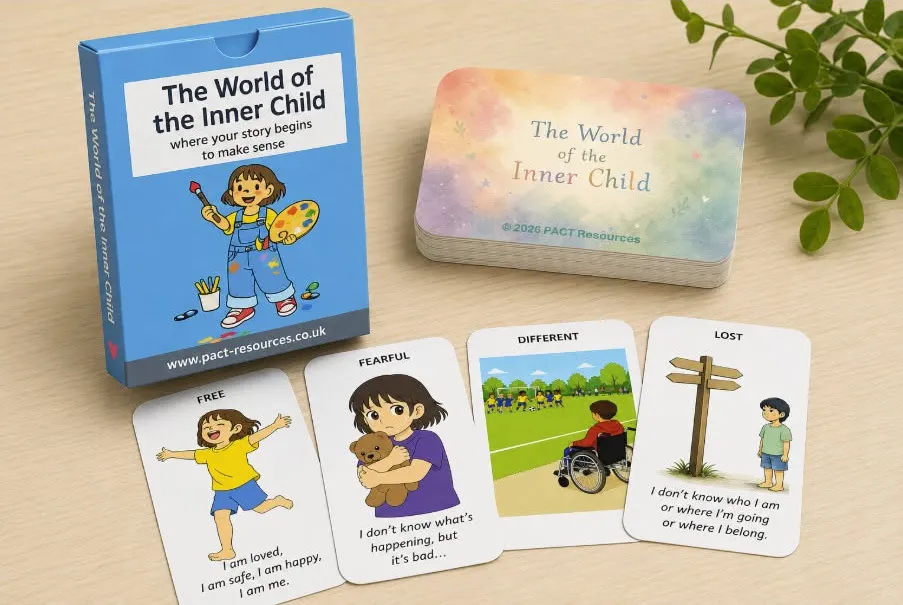
How to Use “The World of the Inner Child” Therapy Card App
The World of the Inner Child is an interactive therapy card app designed to help therapists, counsellors and clients explore younger parts of the self in a gentle, visual and collaborative way. The app can be used in face-to-face sessions, online therapy, reflective exercises, psychoeducation, parts work, trauma-informed practice and inner child work.
The app gives clients a set of illustrated inner child cards, editable card spaces, notes, supportive labels, speech bubbles and custom labels. Together, therapist and client can choose cards that represent feelings, parts, roles, needs or experiences, then build a visual map of what is happening internally.

Watch the video tutorial and demo below…
The World of the Inner Child is an interactive therapy card app designed to help therapists, counsellors and clients explore younger parts of the self in a gentle, visual and collaborative way. The app can be used in face-to-face sessions, online therapy, reflective exercises, psychoeducation, parts work, trauma-informed practice and inner child work.
The app gives clients a set of illustrated inner child cards, editable card spaces, notes, supportive labels, speech bubbles and custom labels. Together, therapist and client can choose cards that represent feelings, parts, roles, needs or experiences, then build a visual map of what is happening internally.
What the App Does
The app allows the therapist and client to:
- Choose up to seven inner child cards and place them into the card spaces.
- Add notes beneath each card.
- Use supportive labels and speech bubbles to add meaning to the cards.
- Create custom labels using the blank speech bubble and blank text label.
- Undo and redo recent changes during the session.
- Save and load a session so the work can be returned to later.
Getting Started
A helpful way to begin is to invite the client to look through the cards slowly and notice which images stand out. They do not need to explain their choices immediately. Sometimes the most useful starting point is simply:
“Which card feels familiar today?”
The client can click a card to place it into the next empty space, or drag it into a specific position. Once a card is placed, the therapist and client can use the note box underneath to capture words, memories, body sensations, beliefs or emotional responses.
Using the Card Spaces
The seven card spaces can be used flexibly. They might represent:
- Different emotional parts of the client.
- Different ages or developmental stages.
- Different roles the client learned to take on.
- Parts that appear in particular relationships.
- Parts that show up during conflict, shame, fear or disconnection.
- A journey from past experience to present-day understanding.
Encourage the client to name the card spaces in their own words. For example: “The part that hides”, “The angry one”, “The child who tries to be perfect”, or “The part that needs reassurance”.
Using Labels and Speech Bubbles
The label section allows the therapist and client to add extra meaning to the cards. Speech bubble labels can be placed near the top of a card, while text labels can be placed near the bottom. These can help distinguish between:
- What a part says.
- What a part needs to hear.
- Old messages the client received.
- New compassionate responses.
- Protective rules or beliefs.
- Reparenting statements.
The blank speech bubble and blank text label allow the therapist or client to type their own words. This can be especially useful when the client has a phrase that feels very personal, such as “Please don’t leave me”, “I need someone to notice”, or “You are safe now”.
Tips for Therapists
- Go slowly. The cards can bring up powerful emotional material. Allow time for grounding and reflection.
- Let the client lead. The meaning of a card should come from the client, not from the therapist’s interpretation.
- Use curiosity, not certainty. Try questions such as “What do you notice?” or “What might this part want us to know?”
- Track the body. Ask what happens physically when a card is chosen or discussed.
- Use the notes section. Capture exact client language where possible.
- Use Undo and Redo freely. This helps clients experiment without worrying about getting it wrong.
- Save the session. If the work feels important, download the JSON session file so it can be continued later.
Ways to Use the App in Therapy
1. Emotional Check-In
Invite the client to choose one to three cards that represent how they feel at the start of the session. This can be especially helpful for clients who struggle to name emotions directly.
Possible prompts:
- “Which card feels closest to how you arrived today?”
- “Is there a card that shows what is happening underneath the surface?”
- “Which part of you feels most present right now?”
2. Mapping Inner Child Parts
Ask the client to choose cards that represent different younger parts of themselves. These might include fearful, angry, sad, hidden, responsible, playful or misunderstood parts.
This can help the client see that they are not “one thing”; they may have several inner parts with different needs, fears and protective strategies.
3. Exploring Protective Roles
Some cards may represent roles the client learned to take on, such as being the responsible child, the invisible child, the caretaker, the performer or the child who adapts to others. These cards can open conversations about survival strategies.
Possible prompts:
- “When did this part first learn to behave this way?”
- “What was this part trying to protect you from?”
- “Does this role still feel useful today, or has it become exhausting?”
4. Reparenting and Compassionate Response
Place a card that represents a younger wounded part, then use a label or custom label to add what that part needs to hear now.
Examples might include:
- “That wasn’t your fault.”
- “You are allowed to have feelings.”
- “I am here with you now.”
- “You do not have to be perfect to be loved.”
5. Working with Shame
For clients who carry shame, the cards can provide a safer external focus. Instead of saying “I am ashamed”, the client might say, “This part feels ashamed”. That small shift can create space, compassion and perspective.
Useful questions include:
- “What does this part believe about itself?”
- “Who taught this part to feel that way?”
- “What would we want this part to know now?”
6. Exploring Family Roles
The app can be used to explore family positions and roles, such as firstborn child, middle child, youngest child, stepchild, twin, glass child or adult child. This can help clients reflect on the expectations, responsibilities and identities they developed within the family system.
7. Before and After Exercise
At the beginning of a session, invite the client to choose cards that represent how things feel now. Later, after reflection or processing, ask whether any cards need to change, move or be labelled differently.
This can help clients notice shifts in understanding, emotional intensity or self-compassion.
8. Parts Dialogue
Choose two or more cards that represent different parts of the client. For example, one part may feel angry, while another feels frightened. Use speech bubbles to explore what each part might say.
Possible prompts:
- “What does this part want the other part to understand?”
- “Are these parts protecting the same wound in different ways?”
- “What might help them feel less alone?”
9. Identifying Needs
Once a card is chosen, ask the client what this part needs. The need might be safety, comfort, boundaries, permission, rest, attention, play, reassurance or protection.
The therapist can then use labels to add a supportive response directly onto the card.
10. Ending the Session Safely
Before closing the app, spend time helping the client return to the present. This might include grounding, naming what has been learned, choosing a supportive label, or identifying one small act of care before the next session.
Possible closing prompts:
- “Which card needs the most care after today’s session?”
- “What would help this part feel held until next time?”
- “What is one sentence you want to take away from today?”
Using the App Online
The app can work well in online sessions. The therapist can share their screen and use the app collaboratively with the client. If using remote control features, it may help to explain the basic controls first: choosing cards, switching to labels, adding notes, using Undo/Redo and saving the session.
Some clients may prefer to tell the therapist which card to choose rather than controlling the screen themselves. Others may enjoy taking control and building the board directly.
Saving and Returning to the Work
The Save / Load feature allows the therapist to download a JSON session file. This preserves the chosen cards, placed labels, custom label text, notes and card titles. The file can be loaded again in a future session so the work can continue from the same point.
As with any therapy notes or client material, saved files should be stored securely and handled in line with your professional, organisational and data protection requirements.
A Trauma-Informed Note
Inner child work can be powerful. For some clients it may bring up grief, anger, fear, shame or traumatic memories. The app is intended to support therapeutic exploration, not rush it. Use the cards as an invitation, not a demand. If a client becomes overwhelmed, pause the activity and return to stabilisation, grounding and choice.
The most important part of the work is not choosing the “right” card. It is helping the client feel seen, understood and accompanied.
Final Thought
The World of the Inner Child can help clients give shape, colour and language to parts of themselves that may have been hidden, dismissed or misunderstood. Used gently, it can support emotional literacy, self-compassion, parts work and deeper therapeutic reflection.
Above all, the app works best when it is used collaboratively: therapist and client looking together, wondering together, and making space for the younger parts of the self to be heard with care.
Get the Physical Cards
The phsyical pack contains 45 colourful images of the Inner Child, showing different emotions, activities, relationships and situations. Designed for counsellors and psychotherapists, the cards will open conversations with clients as they see themselves in the pictures and identify with the feelings. Also included are 8 “Don’t” cards – examples of Transactional Analysis injunctions, and also 12 cards which offer ways of expressing kindness and nurture to the Inner Child.